
Copied
UEG Week 2026
Learn more about nutrition research highlights for gastrointestinal disorders addressed at UEG Week 2026.
In October 2026, GI Nutrition Foundation attended United European Gastroenterology (UEG) Week 2026 in Barcelona, Spain. The meeting attracted >14,000 participants from 122 countries, according to the organizers.
A broad range of sessions covered diet and nutrition topics across different gastrointestinal disorders, as well as wider topics of interest to the nutrition community. The postgraduate teaching program included interactive case discussions on causes of villous atrophy beyond celiac disease, how to safely refeed patients with anorexia nervosa, and tips and tricks to manage chronic constipation, including the role of diet and lifestyle changes. The first evidence-based British Dietetic Association (BDA) dietary guidelines for constipation showed that psyllium, specific probiotic strains, kiwifruits, prunes, rye bread and water containing high concentrations of minerals may improve some constipation outcomes1. An update of the BDA guidelines for the dietary management of IBS will be published soon.
Despite the longstanding clinical advice to eat more dietary fiber, few randomized trials have investigated this advice for treating constipation.
The role of diet and nutrition in prevention and management of gastrointestinal disorders was also a prominent topic discussed at the meeting, including what’s new in nutritional therapies for IBD induction therapy, the benefits of the Mediterranean diet for lowering the risk of cardiovascular disease, mental disorders and cancer that every patient with IBD carries, and nutrition support before IBD surgery.
The INTERCEPT project brought together scientific insights and the perspectives of patients and families to transform Crohn’s disease research by shifting from reactive symptom management to proactive early detection and prevention. Whole-food dietary approaches are emerging as a potentially feasible and effective alternative to exclusive enteral nutrition for managing Crohn’s disease2. Integrating nutrition with biologics is the next frontier and needs to address when and for whom it adds benefit3,4. Food restriction can become a problem in patients with gut disorders and experts argue that eating behaviors may be better conceptualized along a continuum rather than distinct entities, from adaptive to rigid and maladaptive (i.e., avoidant/restrictive food intake disorder) behaviours5.
The future of IBD is not about choosing between diet and drugs - it’s about the right approach, for the right patient, at the right stage of disease.
Timely topics such as personalized nutrition and the gut microbiome were also discussed. A session focused on innovations in gut microbiota and therapeutics, featuring the gut microbiota as a diagnostic tool, the strong efficacy of fecal microbiota transplantation in recurrent Clostridioides difficile and potential interest in IBD and immuno-oncology6, while limited efficacy in IBS based on the largest phase 3 randomized trial7. A novel elemental diet reduced visceral and subcutaneous fat while preserving skeletal muscle in mice, mirroring the findings of a previous clinical trial in adults with positive lactulose breath tests for small intestinal bacterial overgrowth and/or intestinal methanogen overgrowth8.
Collecting clinical history is the best way to identify who can benefit from gut microbiota modulation. Diet rather than expensive microbiome tests should be the starting point.
Posters addressed translational and clinical science on dietary management of common gastrointestinal disorders, including the effectiveness of food elimination diets in adults with eosinophilic esophagitis, the superior role of a low FODMAP diet to traditional dietary advice for achieving symptom relief and quality of life in postprandial functional dyspepsia, and the benefits of dietary therapy in IBS resulting from multiple concurrent nutritional mechanisms (i.e., reduced fatty food and ultra-processed food consumption) rather than isolated FODMAP restriction alone.
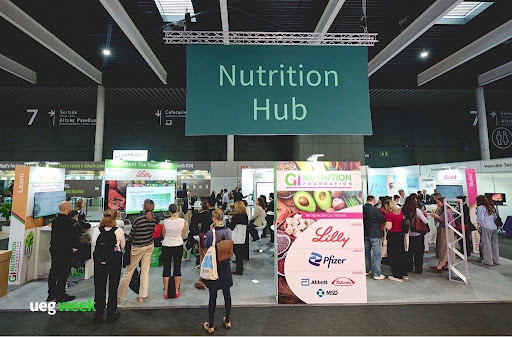
This year, UEG Week also hosted the Nutrition Hub, an 80 m2 interactive space designed to bring evidence-based nutrition science from bedside to plate for healthcare professionals. It included four interactive learning stations focused on the preventive role of nutrition in gastrointestinal tract diseases, expert talks, tastings of fiber-rich recipes, and digital resources to support clinical practice.
UEG Week 2027 will take place in Copenhagen, Denmark, on 16-19 October 2027.
References:
- Dimidi E, van der Schoot A, Barrett K, et al. British Dietetic Association guidelines for the management of chronic constipation in adults. J Hum Nutr Diet. 2025; 38(5):e70133. doi: 10.1111/jhn.70133.
- Aharoni-Frutkoff Y, Plotkin L, Pollak D, et al. Whole food diet induces remission in children and young adults with mild to moderate Crohn’s disease and is more tolerable than exclusive enteral nutrition: a randomized controlled trial. Gastroenterology. 2025; 169(7):1462-1474.e2. doi: 10.1053/j.gastro.2025.06.011.
- Pochesci S, Scarallo L, Miraglia T, et al. Crohn’s disease exclusion diet as an add-on to antitumor necrosis factor-α therapy in children with moderate-to-severe Crohn’s disease. J Pediatr Gastroenterol Nutr. 2025; 81(5):1237-1241. doi: 10.1002/jpn3.70208.
- Li D, Kong Y, Ye X, et al. Effects of modified Crohn’s Disease Exclusion Diet as adjunctive therapy on clinical remission and nutrition in pediatric Crohn’s disease: a real world study from China. Children. 2025; 12(11):1479. doi: 10.3390/children12111479.
- Routhiaux K, Mikhael-Moussa H, Burton-Murray H, et al. From adaptive to maladaptive eating behavior in disorders of gut-brain interaction. Neurogastroenterol Motil. 38(6):e70379. doi: 10.1111/nmo.70379.
- Porcari S, Ciccarese C, Heidrich V, et al. Fecal microbiota transplantation plus pembrolizumab and axitinib in metastatic renal cell carcinome: the randomized phase 2 TACITO trial. Nat Med. 2026; 32(4):1316-1324. doi: 10.1038/s41591-025-04189-2.
- Johnsen PH, Emil Juul F, Lihaug Hoff DA, et al. Faecal microbiota transplantation in irritable bowel syndrome (REFIT2): a randomised, double-blind, placebo-controlled, phase 3 trial. Lancet. 2026. doi: 10.1016/S0140-6736(26)01424-8.
- Rezaie A, Chang BW, de Freitas Germano J, et al. Effect, tolerability, and safety of exclusive palatable elemental diet in patients with intestinal microbial overgrowth. Clin Gastroenterol Hepatol. 2025; 23(12):2306-2317.e7. doi: 10.1016/j.cgh.2025.03.002.

Andreu Prados is a science and medical writer specializing in making reliable evidence of non-prescription therapeutics for gastrointestinal conditions understandable, engaging and ready for use for healthcare professionals and patients.


Support our Mission
Your donation will help us to enhance the well-being and health outcomes of patients with GI conditions.
Donate